
Yes. One important safety correction: I would not tell readers to manufacture the actual solar-filter lenses from household materials. NASA and the American Astronomical Society warn that sunglasses, smoked glass, photographic film, etc. are unsafe. We can still make the article highly clickable around “DIY eclipse glasses,” but the DIY part should use certified ISO 12312-2 solar-filter material in a homemade cardboard frame or show readers how to build a completely homemade pinhole eclipse viewer, which requires no special filter.
And yes the eclipse really is today, Wednesday, August 12, 2026. In the Netherlands it begins around 19:16, peaks around 20:11, with roughly 88–90% of the Sun covered, and ends around 21:03, very close to sunset.
Prepare Your DIY Solar Eclipse Glasses — The Solar Eclipse Is Happening TODAY!
Look toward the sky this evening, because something extraordinary is about to happen.
Today, Wednesday, August 12, 2026, the Moon will move directly between Earth and the Sun, producing one of the most spectacular astronomical events of the year: a solar eclipse.
Across parts of Greenland, Iceland and northern Spain, observers will experience a total solar eclipse, where the Moon completely covers the Sun for a brief period.
But you don’t have to be standing directly underneath the path of totality to experience it.
Across a huge portion of Europe, millions of people will witness an impressive partial solar eclipse.
And if you’re in the Netherlands, this one is particularly special.
The Netherlands Will See Almost 90% of the Sun Disappear
The eclipse will begin in the Netherlands at approximately 19:16 (7:16 PM).
Over the following hour, the Moon will slowly move farther across the face of the Sun.
At approximately 20:11 (8:11 PM), the eclipse reaches its maximum.
At that moment, roughly 88–90% of the Sun’s visible disk will be covered by the Moon.
The eclipse continues until approximately 21:03 (9:03 PM), close to sunset.
Because the Sun will already be very low in the sky, your location matters.
Find somewhere with a clear, unobstructed view toward the northwest. Beaches, open fields, elevated areas and places without tall buildings or trees blocking the horizon could offer some of the best views.
This is the largest partial solar eclipse visible from the Netherlands for decades.
So if the weather cooperates, tonight could become one of those evenings people remember.
What Actually Happens During a Solar Eclipse?
A solar eclipse happens because of an extraordinary alignment.
The Sun is enormous compared with the Moon. In fact, the Sun’s diameter is roughly 400 times larger than the Moon’s.
But the Sun is also roughly 400 times farther away from Earth.
Because of that remarkable relationship, the Sun and Moon appear surprisingly similar in size when viewed from Earth.
During a solar eclipse, the Moon passes between Earth and the Sun.
For people standing inside the narrow path of totality, the Moon can completely cover the brilliant surface of the Sun.
Today that path crosses remote parts of the Arctic before moving across Greenland, Iceland, the Atlantic and northern Spain.
Outside that narrow path, the alignment isn’t quite perfect.
Instead, observers see the Moon apparently taking an increasingly enormous “bite” out of the Sun.
That is what much of Europe including the Netherlands will experience tonight.
Watch What Happens Around You
Don’t spend the entire eclipse looking upward.
Look around you.
As more of the Sun disappears, the quality of daylight can begin to change.
The landscape may develop an unusual dimness.
Temperatures can temporarily fall because significantly less solar radiation reaches the ground. Scientists have even studied changes in winds, clouds and atmospheric conditions during eclipses.
And there’s another beautiful phenomenon you can look for.
Stand underneath a leafy tree during the eclipse and look at the ground.
Normally the tiny gaps between leaves project circular images of the Sun.
During a partial eclipse, those circles transform into hundreds of tiny crescents.
Every small opening between the leaves essentially becomes a natural pinhole projector.
⚠️ But There Is One Extremely Important Warning
DO NOT LOOK DIRECTLY AT THE SUN WITHOUT PROPER SOLAR PROTECTION.
This remains true even when 80%, 90% or even 99% of the Sun is covered.
The remaining portion of the Sun is still intensely bright and capable of damaging the retina.
And because the Netherlands will experience a partial eclipse rather than totality, there is no moment during today’s eclipse when it becomes safe to stare directly at the Sun without proper protection.
Ordinary sunglasses are NOT sufficient.
Neither are:
- Multiple sunglasses stacked together
- Smoked glass
- CDs or DVDs
- Food wrappers
- Tinted plastic
- Camera film
- Photographic negatives
- Homemade darkened glass
Something appearing dark enough does not mean that harmful solar radiation has been filtered sufficiently.
Proper eclipse glasses use specialized solar-filter material designed specifically for direct solar viewing.
Look for products conforming to the ISO 12312-2 international safety standard from a reputable manufacturer or supplier.
How to Make DIY Solar Eclipse Glasses Safely
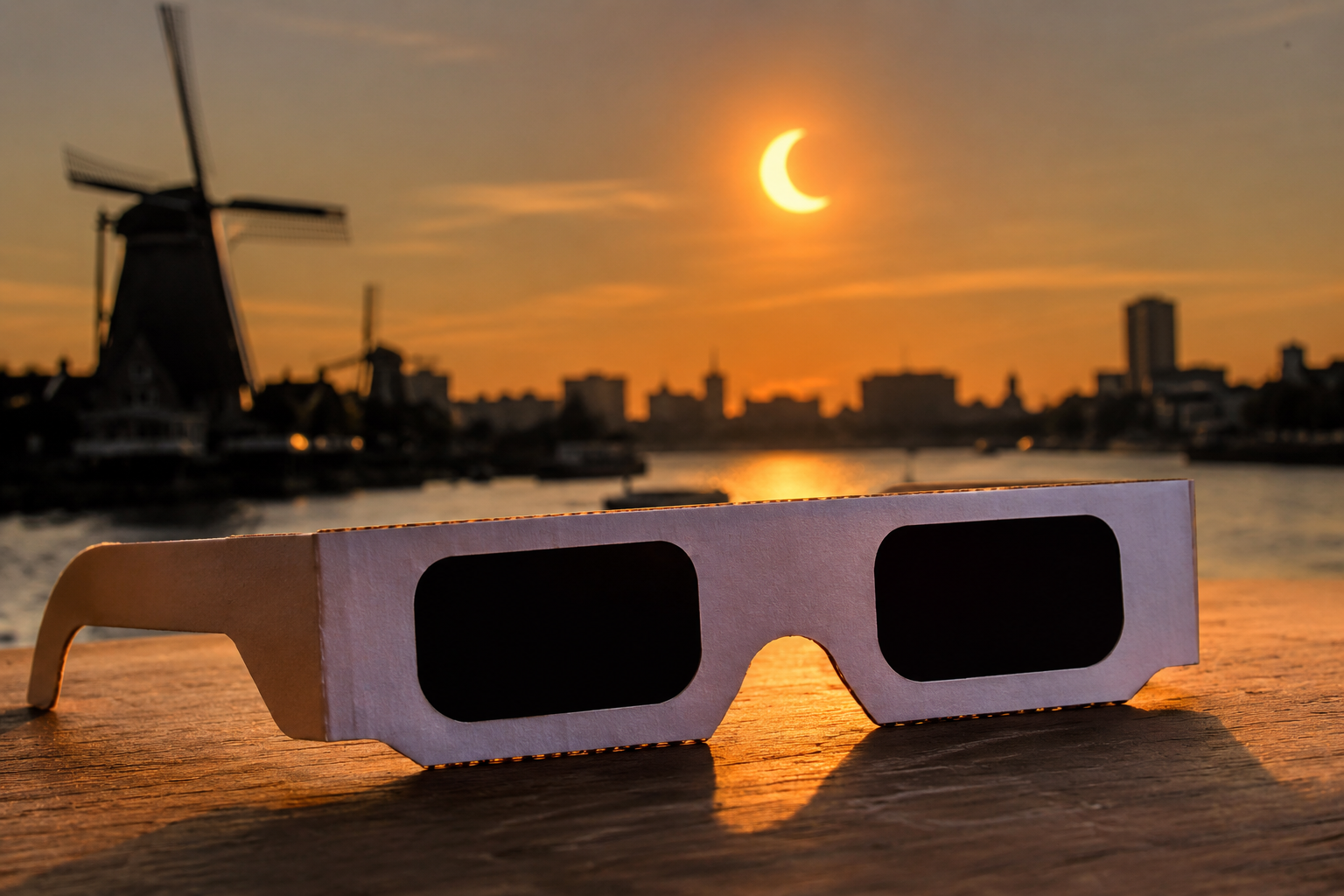
You can make the frame yourself, but the solar filter itself should not be homemade.
You will need:
Cardboard or thick paper
Scissors
Tape
A pencil
Certified solar-viewing filter material meeting ISO 12312-2 requirements
Step 1 — Make Your Frame
Take a piece of cardboard and draw the shape of a large pair of glasses.
Make them larger than ordinary glasses.
You want plenty of cardboard surrounding your eyes so that sunlight can’t easily enter around the sides.
Cut the frame out.
Step 2 — Create the Viewing Windows
Carefully cut two rectangular openings where your eyes will be.
Don’t make them unnecessarily large.
The openings only need to provide a comfortable viewing area.
Step 3 — Cut Your Certified Solar Filter
Cut two pieces of your certified solar-filter material slightly larger than the openings.
Be extremely careful not to scratch, puncture or tear the filter.
Step 4 — Attach the Filter
Place the solar-filter material over the openings from the inside of the cardboard.
Tape securely around the edges.
There should be no gaps between the filter and the cardboard.
Step 5 — Inspect Everything
Before using them, hold the glasses normally and inspect the filter carefully.
If you see:
Scratches
Holes
Tears
Loose sections
Damaged filter material
don’t use them.
Replace the filter.
Step 6 — Put Them On BEFORE Looking Toward the Sun
This is important.
Put your eclipse glasses on before turning your face toward the Sun.
Then look.
When you’re finished, turn away from the Sun before removing them.
No Solar Filter? Build This Instead.
Maybe you’re reading this only hours before the eclipse.
You don’t have eclipse glasses.
You can’t find certified solar-filter material.
Don’t experiment with homemade filters.
Instead, build one of the simplest astronomical instruments imaginable:
A DIY Pinhole Eclipse Projector
You need:
Two pieces of white cardboard or paper
A pin, needle or small sharp object
That’s basically it.
Make one tiny round hole in the center of one piece of cardboard.
Now go outside.
Stand with your BACK toward the Sun.
Hold the cardboard containing the hole above your shoulder so sunlight passes through it.
Place the second piece of white cardboard in front of you.
The tiny hole will project an image of the Sun onto the second piece.
As the eclipse progresses, something incredible happens.
The projected circle will slowly transform into a crescent as the Moon crosses the Sun.
Move the two pieces farther apart to make the projected image larger.
IMPORTANT:
You are NOT supposed to look through the hole at the Sun.
You are looking at the projection on the second piece of cardboard.
NASA and the American Astronomical Society recommend pinhole projection as a safe method of indirectly observing the partially eclipsed Sun.
You Can Even Use Your Hands
There’s an emergency eclipse viewer you’re carrying with you right now.
Your fingers.
Turn your back toward the Sun.
Stretch out both hands and overlap your fingers, creating lots of tiny openings between them.
Now look at the shadow of your hands on the ground.
During the partial eclipse, those little openings can project multiple tiny crescent-shaped images of the eclipsed Sun.
A kitchen colander can produce the same spectacular effect.
Hold it above the ground with your back toward the Sun and watch dozens of miniature eclipses appear inside its shadow.
Don’t Look Through Binoculars or a Telescope
This warning deserves special attention.
Never point binoculars, a telescope or an unfiltered camera directly toward the Sun and then look through it.
Optical equipment concentrates sunlight.
Solar viewing through telescopes, binoculars and cameras requires appropriate solar filters mounted correctly over the front of the optics.
Eclipse glasses alone are not a substitute for a proper telescope or binocular solar filter.
If you don’t have the appropriate equipment, enjoy the eclipse with certified eclipse glasses or use projection instead.
Tonight’s Eclipse Is Bigger Than the Netherlands
While people in the Netherlands watch the Sun turn into a thin crescent, observers farther north and south along a narrow corridor will experience something even more dramatic.
The path of totality crosses parts of Greenland, Iceland, northern Spain and a small part of Portugal.
Within that path, the Moon completely covers the bright solar surface.
For a brief moment, daytime turns toward darkness and the Sun’s outer atmosphere—the corona—can become visible.
Northern Spain will experience totality shortly before sunset, making today’s eclipse particularly unusual.
For most of the rest of Europe, however, the eclipse remains partial.
That means eye protection remains essential.
One More Cosmic Coincidence: Look Up Again Tonight
August 12 is already a remarkable date for sky watchers because it falls around the annual peak of the Perseid meteor shower.
So after watching the eclipse around sunset, the astronomical show doesn’t necessarily have to end.
Hours later, under darker skies, you may have another reason to look upward.
First the Moon moves across the Sun.
Then night arrives.
Then the Perseids take over.
Not a bad day to spend some time looking at the sky.
Prepare Before This Evening
You still have time.
Find your viewing location.
Check that you have a clear view toward the northwestern horizon.
Get genuine eclipse glasses or certified ISO 12312-2 solar-filter material.
Or spend five minutes building a pinhole projector.
Then watch.
Because beginning around 19:16, the Moon starts moving across the Sun from our perspective in the Netherlands.
Around 20:11, nearly 90% of the solar disk will be hidden.
And shortly afterward, the eclipsed Sun will descend toward the horizon.
For a short period this evening, millions of people across Europe will stop what they’re doing and look toward the same object in the sky.
Just make sure you do it safely.
Share this article with your family and friends before tonight’s eclipse—especially with anyone who might otherwise try to watch it through ordinary sunglasses.
The astronomy and Netherlands timing in the article are based on current eclipse reporting; the Dutch eclipse is expected to begin around 19:16, peak around 20:11 at roughly 88–90% coverage, and finish around 21:03. The safety instructions follow NASA/AAS guidance, including pinhole projection and the warning that ordinary sunglasses and improvised filters are unsafe.
I can also create a hyper-realistic featured image showing the nearly 90% eclipsed Sun over the Netherlands with DIY eclipse glasses in the foreground for the article.
🌑 Watch the Solar Eclipse LIVE on Kemetic App
Can’t get a clear view of the eclipse where you are? Watch it together with the Family on Kemetic App.
Join us on Kemetic App as we follow today’s solar eclipse and experience this astronomical event together with our worldwide community.
📱 Download Kemetic App
Don’t wait until the eclipse begins. Download the app now, create your account and be ready when we go live.
🍎 iPhone & iPad:
https://apps.apple.com/app/kemetic-app/id6479200304?l=en-GB
🤖 Android:
https://play.google.com/store/apps/details?id=com.app.kemeticapp&pcampaignid=web_share&pli=1
Once you have the app, look for the LIVE section and join the Family.
🔔 Become a Member — Don’t Miss the Next Event
The solar eclipse is only one of the events we follow.
Become a Kemetic App Member and become part of a growing learning and knowledge community exploring ancient history, spirituality, consciousness, science, nature, hidden history and the events happening in our world.
As a member, you can:
- 🎓 Access our growing library of courses and educational content
- 📚 Explore books, articles, research and ancient knowledge
- 📺 Watch exclusive videos, lectures and livestreams
- 🔔 Receive updates about important upcoming events and broadcasts
- 🌍 Join a worldwide community of people learning and exploring together
- 💬 Participate in conversations with other members
- 🧠 Go deeper into topics that cannot be fully explored in a short social-media post
- 📱 Keep your learning with you through the Kemetic App
🌍 Join the Kemetic App Community
Social media gives you a post.
Kemetic App gives you the entire journey.
Instead of hoping an algorithm shows you our next livestream, article or discovery, become part of the community directly.
👉 BECOME A KEMETIC APP MEMBER:
https://kemetic.app/membership
🌑 Tonight, We’re Looking Up Together
Prepare your eclipse glasses.
Find a clear view of the horizon.
Download Kemetic App.
And when the eclipse begins, join the Family LIVE.
Whether you’re watching from the Netherlands, elsewhere in Europe or somewhere across the world, we can experience this extraordinary moment together.
Download Kemetic App. Become a member. Join the community. And don’t miss what comes next.