

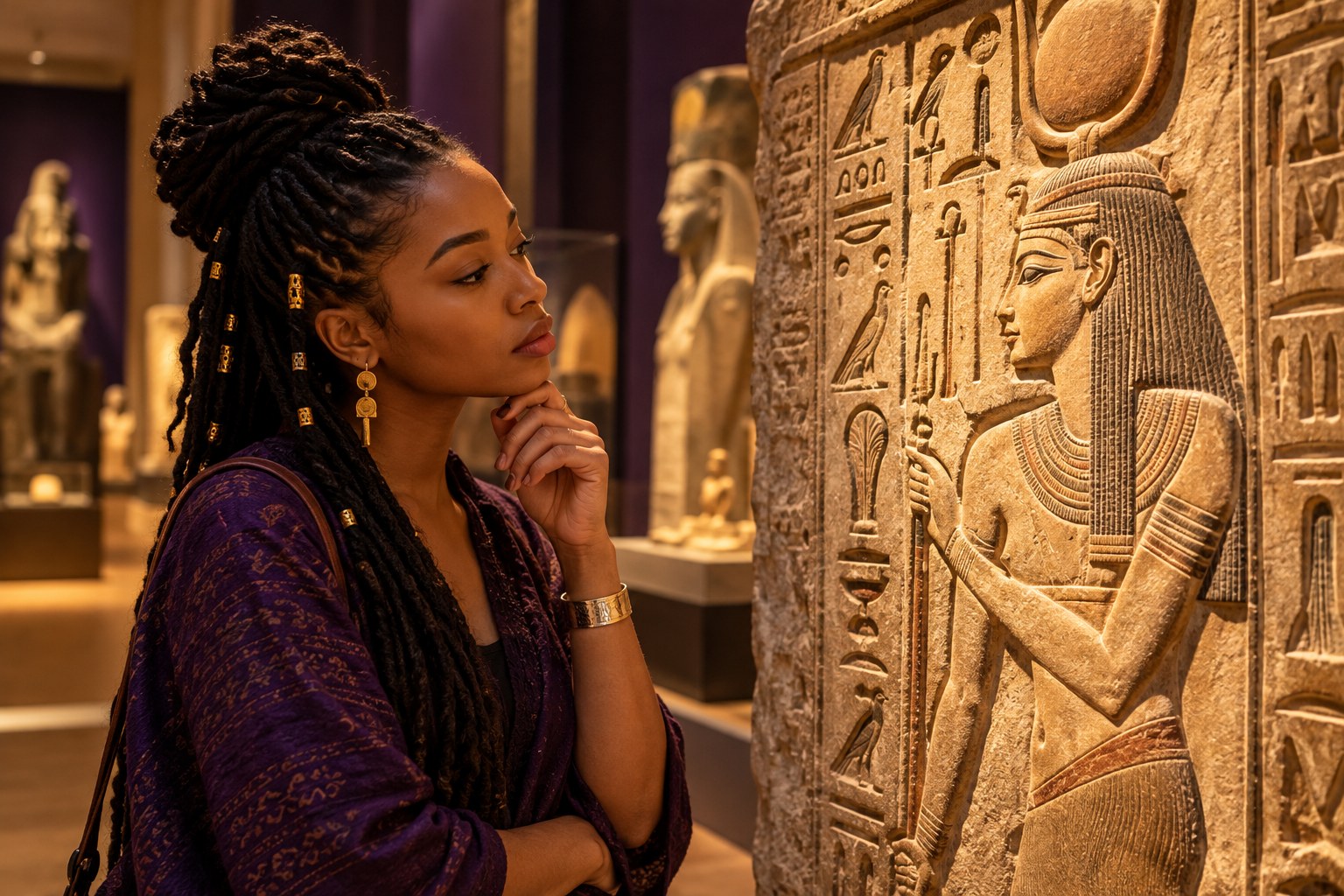
Ancient wisdom becomes more interesting when you know where an idea comes from. A quotation shared online may contain a thoughtful message, yet its author, date or translation may be uncertain.
Learning with context helps you appreciate a tradition while making deliberate choices about how to use its teachings today.
Begin with a Traceable Example
Ma’at offers a useful starting point. The Metropolitan Museum describes a figure of Ma’at as representing truth, justice and an ideal world in equilibrium.[1] The object and its description provide a historical reference you can examine.
You might use that context to reflect on fairness in a conversation. That exercise is a present-day application; it is not evidence that ancient Egyptians followed the exact modern exercise you designed.
Naming the distinction respects both history and your own contribution.
Ask Four Source Questions
Where is the teaching recorded? Who translated or interpreted it? What was its original setting? Which part is a modern addition?
A museum object, an academic discussion and a contemporary teacher’s commentary can all be useful. They serve different purposes.
When a quotation has no identifiable source, share it as an unattributed idea rather than assigning it to an ancient civilization.
Choose an Everyday Situation
Pick a situation where the idea can become a question. For Ma’at, you might ask: “Have I represented another person’s position fairly?”
Consider a disagreement you had recently. Write your perspective, then try to state the other person’s position without ridicule or exaggeration.
That reflection does not settle who is right. It gives you a more careful starting point for discussion.
Avoid Collapsing Traditions Together
Similar words do not establish identical histories. Ancient Egyptian teachings, later Hermetic texts and Indian contemplative traditions arose in different contexts.
Connections can be explored as comparisons. Explain the similarities you notice and the differences you can document.
A broad claim such as “all ancient cultures taught the same system” needs evidence that an inspiring comparison alone cannot provide.
Build a Small Study Practice
Choose one source and one question for the week. Take notes on the material, the author’s interpretation and your own response.
If you discuss it on Kemetic App, link the source and identify which statements are historical descriptions and which are personal reflections.
Ancient wisdom does not need an exaggerated origin story to be worth studying. Careful reading, respectful questioning and a practical application can make the learning meaningful.
Continue Learning
Explore the Spirituality learning collection for related teachings. For a deeper learning option, review The Hermetic Laws: Universal Principles for Personal Growth and its curriculum.
You can also read Kemet Spirituality: Reconnecting with Ancient Wisdom.
For optional additional reading, explore The 42 Laws of Ma’at: A Guide to Living in Truth and Balance. This commercial resource is separate from the evidence and reference links below; review its details and access terms before purchasing.
Sources and Further Reading
These links support the factual context or offer further study. The reflection exercises and examples in this article are original educational suggestions.