
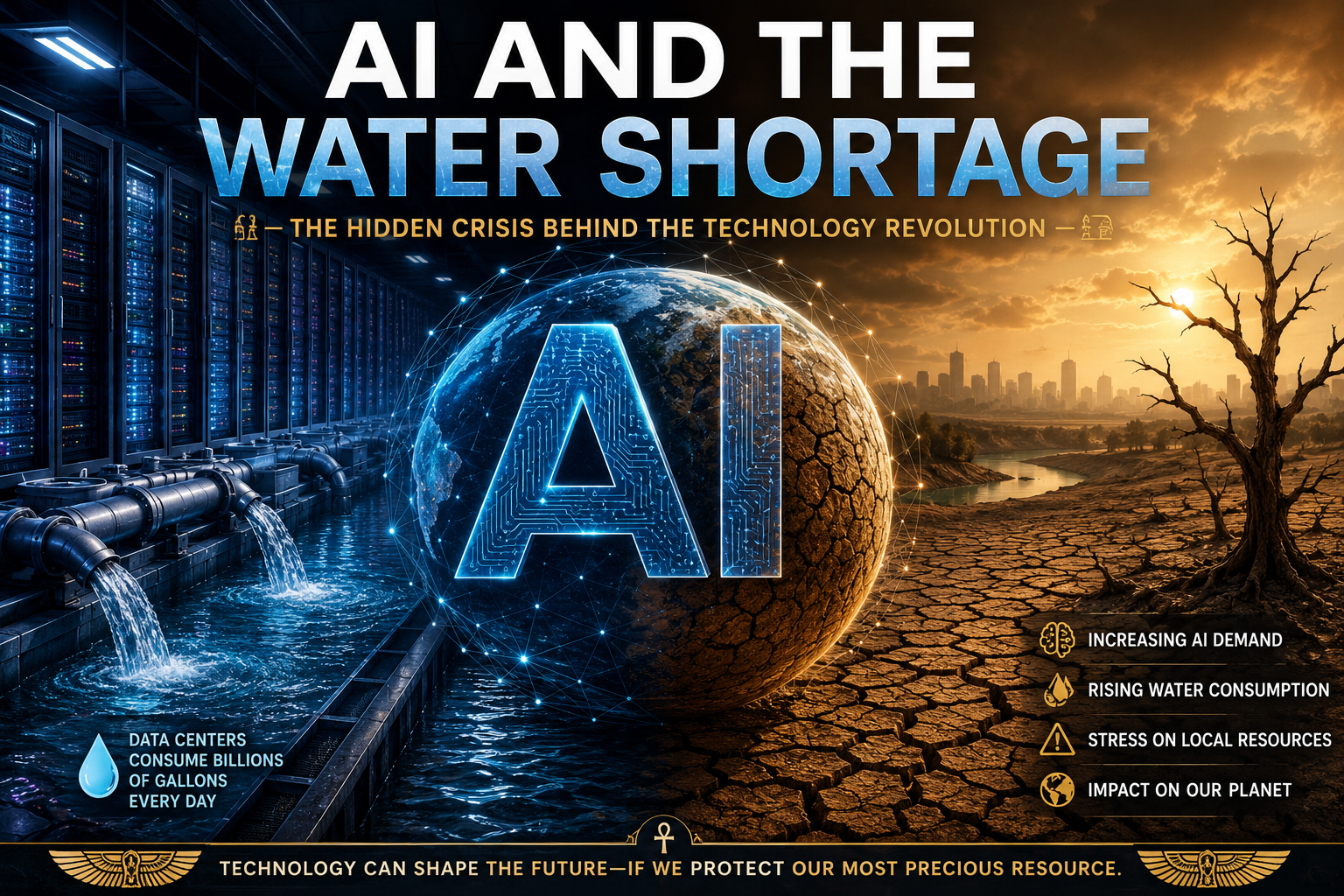
Is Artificial Intelligence Creating a Global Water Crisis?
Artificial Intelligence is rapidly becoming one of the most powerful technologies humanity has ever created. It is helping businesses automate tasks, assisting doctors with medical research, powering self-driving vehicles, generating images and videos, and transforming how people work and communicate.
But behind the excitement surrounding AI lies a growing concern that few people are discussing.
Could Artificial Intelligence contribute to future water shortages around the world?
The answer is more complex than many headlines suggest.
The Hidden Infrastructure Behind AI
When most people think about AI, they imagine software running inside a phone or computer. What many do not realize is that AI requires enormous physical infrastructure.
Every question asked to an AI system, every image generated, and every video processed requires powerful computers operating inside massive data centers.
These facilities contain thousands of high-performance processors working around the clock.
Unlike a laptop sitting on a desk, these processors generate tremendous amounts of heat.
Heat is the enemy of computer systems.
If temperatures rise too high, equipment can fail, become damaged, or lose performance.
To prevent this, data centers must be cooled continuously.
And this is where water enters the conversation.
All-in-one AI Video and Image Solution of Veo3,Runway,Seedance etc | Viddo AI
Why AI Uses Water
Many modern data centers rely on water-based cooling systems.
Water absorbs heat very efficiently, making it one of the most cost-effective methods for keeping servers operational.
Large facilities circulate water through cooling towers where heat is released into the atmosphere.
As part of this process, some water evaporates and must be replaced.
This means that every day, significant amounts of fresh water are consumed to keep these digital systems running.
As AI demand increases, more data centers are being built around the world.
More data centers mean more electricity consumption.
More electricity consumption often means more cooling.
More cooling can mean more water use.
This has led some researchers and environmental organizations to warn that AI could place additional pressure on water resources, especially in regions already struggling with drought.
How Much Water Are We Talking About?
The numbers can be surprising.
Training a large AI model can require substantial amounts of electricity and cooling resources.
Individual AI interactions may consume only a tiny amount of water indirectly, but when billions of requests occur daily across multiple platforms, the total adds up.
Some estimates suggest that large AI systems may indirectly use hundreds of millions of gallons of water annually when considering both data center cooling and electricity generation.
Many power plants also consume water for cooling, meaning the water footprint extends beyond the data center itself.
This is why experts often refer to AI’s “hidden water footprint.”
Most users never see it.
Yet it exists behind every digital interaction.
All-in-one AI Video and Image Solution of Veo3,Runway,Seedance etc | Viddo AI
Is AI Really Causing Droughts?
This is where the discussion requires careful examination.
The simple answer is:
No, AI is not currently the primary cause of global droughts.
Droughts are driven by many factors including:
- Climate change
- Rising global temperatures
- Deforestation
- Population growth
- Agricultural water use
- Industrial consumption
- Poor water management
- Changes in rainfall patterns
Agriculture remains by far the largest consumer of freshwater globally.
Crop irrigation, livestock production, and food systems use vastly more water than AI data centers.
However, this does not mean AI’s water consumption should be ignored.
The concern is not necessarily what AI consumes today.
The concern is what happens if AI demand grows exponentially over the next decade.
The Real Risk
The real issue is concentration.
Many large data centers are built near urban areas where internet infrastructure is strong and electricity is readily available.
Unfortunately, some of these regions already face water stress.
When a large data center is constructed in an area experiencing recurring drought conditions, local communities may worry that valuable water resources are being diverted toward technology infrastructure rather than residential or agricultural needs.
This creates tension between technological advancement and environmental sustainability.
If AI continues expanding at its current pace, governments and companies will need to carefully consider where future facilities are located and how they are cooled.
Are There Solutions?
Fortunately, the industry is already exploring solutions.
Several approaches could dramatically reduce AI’s water footprint.
Advanced Cooling Technologies
New cooling systems are being developed that use significantly less water than traditional methods.
Some facilities use closed-loop systems that recycle water repeatedly rather than consuming fresh supplies.
Liquid Immersion Cooling
Instead of cooling air around computer chips, some companies are placing hardware in specialized non-conductive liquids that absorb heat far more efficiently.
This can reduce water requirements substantially.
Renewable Energy Integration
Many technology companies are investing in renewable energy sources to reduce the indirect environmental impact associated with electricity generation.
Strategic Data Center Placement
Building facilities in cooler climates or regions with abundant water resources can reduce environmental pressure on vulnerable communities.
All-in-one AI Video and Image Solution of Veo3,Runway,Seedance etc | Viddo AI
Should We Be Concerned?
The answer is yes but not panicked.
AI’s water consumption is a legitimate issue that deserves public discussion.
Ignoring it would be irresponsible.
At the same time, portraying AI as the sole cause of future droughts would be inaccurate.
The world’s water challenges are the result of multiple interconnected systems.
AI is one piece of a much larger puzzle.
What matters most is ensuring that technological progress does not outpace environmental responsibility.
Humanity has repeatedly developed powerful technologies without fully understanding their long-term consequences.
The opportunity before us today is different.
We can identify potential problems early and design solutions before they become crises.
Artificial Intelligence has the potential to transform civilization in extraordinary ways.
The question is whether we can build that future while protecting one of Earth’s most precious resources water.
Because regardless of how advanced technology becomes, every human, animal, plant, and ecosystem still depends on the same fundamental resource for survival.
And unlike data, water cannot be replaced.
All-in-one AI Video and Image Solution of Veo3,Runway,Seedance etc | Viddo AI